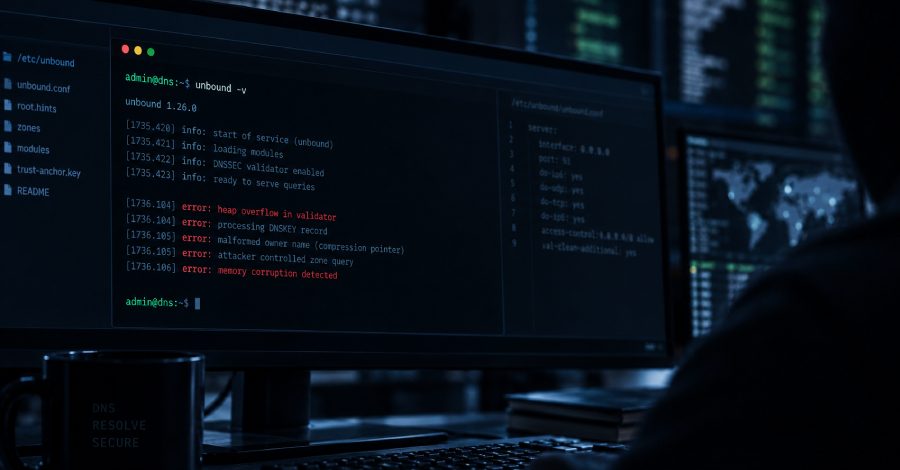

Imagine a quiet afternoon at a small hosting company. The IT team is sipping coffee, confident that their DNS resolver is doing its job, quietly translating human friendly domain names into the IP addresses that keep websites online. Then, without warning, a single malicious DNS zone triggers a catastrophic failure. That scenario is not fiction. It is the reality described in a recent advisory from NLnet Labs, the maintainer of the Unbound DNS resolver.
According to the advisory published on Wednesday, every release of Unbound before version 1.26.1 contains a critical heap overflow in its DNSSEC validator. An attacker who controls a malicious zone and can query a vulnerable resolver could exploit this flaw to achieve remote code execution. In plain terms, that means an attacker might run their own code on the affected server, potentially taking full control of the system.
Why DNSSEC Validation Matters for Domain Owners
DNSSEC, or Domain Name System Security Extensions, is the set of cryptographic safeguards that prevent attackers from forging DNS responses. When a resolver validates DNSSEC signatures, it ensures that the answer it receives actually comes from the legitimate domain owner and has not been tampered with along the way. Without that validation, cybercriminals could redirect visitors to fake websites, intercept email, or worse, impersonate a brand entirely.
Unbound is one of the most widely used validating, recursive, and caching DNS resolvers in the world. It powers countless internet service providers, enterprise networks, and yes, many domain registrars and web hosting platforms. That popularity makes the heap overflow flaw particularly dangerous, because a single unpatched resolver can become a gateway for widespread compromise.
The bug, tracked as CVE-2026-81642, was fixed in Unbound 1.26.1, which was released on the same day as the advisory. If you run Unbound in any capacity, whether for your own domains or as part of a hosting stack, updating immediately is not optional. It is the digital equivalent of locking your front door after discovering that the lock was made of paper.
How a Malicious Zone Turns Into a Remote Takeover
To understand the risk, picture the DNS as a giant, distributed phone book. When your browser asks for the address of a website, your resolver looks up the answer, often querying authoritative name servers for the domain. If the domain uses DNSSEC, the authoritative server also provides cryptographic signatures that the resolver must validate.
In the case of this vulnerability, a specially crafted DNSSEC response from a malicious zone can overflow a heap buffer inside Unbound. Heap overflows are among the most serious classes of memory safety bugs because they allow an attacker to overwrite adjacent memory and potentially hijack the program’s execution flow. Remote code execution is the worst case outcome, and that is exactly what this flaw enables under the right conditions.
The attacker does not need to be on the same network as the resolver. They only need to control a DNS zone and convince a vulnerable resolver to query it. That could happen when a user visits a malicious website, opens a phishing email, or simply when the resolver receives a query for a domain the attacker has registered. The barrier to entry is low, which is why security researchers are urging immediate patching.
What This Means for Domain Investors and Registrars
If you own a portfolio of domain names, you might think that a DNS resolver bug is someone else’s problem. But the domain industry is deeply interconnected. Registrars, hosting providers, and even parking services often rely on Unbound or similar resolvers to handle DNS traffic. A compromise at that layer can lead to domain hijacking, unauthorized transfers, or brand damage that takes months to repair.
For domain investors, the reputational risk is real. Imagine a valuable domain that suddenly resolves to a spam site because an attacker exploited a resolver flaw to poison the cache. Buyers and partners may not care about the technical details; they only see that your domain is associated with malicious activity. That kind of stain can reduce a domain’s valuation and make it harder to sell, even after the issue is fixed.
This is why choosing a registrar that prioritizes security and timely updates matters. At Register it, we offer free domain registration and web hosting with a focus on keeping your online presence safe and reliable. Whether you are launching a new brand or managing a large portfolio, having a registrar that understands the importance of DNS security can save you from headaches down the road.
Practical Steps to Protect Your Infrastructure
First, verify whether your systems use Unbound. If they do, upgrade to version 1.26.1 without delay. If you rely on a managed DNS service or a hosting provider, ask them directly when they plan to apply the patch. A transparent answer is a good sign; vague reassurances are not.
Second, consider limiting which resolvers can be queried from the public internet. If your Unbound instance is only meant to serve internal clients, firewall it so that external attackers cannot reach it. This simple step reduces the attack surface dramatically.
Third, keep an eye on DNSSEC adoption across your domains. While this particular flaw is in the validator itself, DNSSEC remains a powerful tool for preventing DNS spoofing. Registrars like Register it can help you enable DNSSEC for your domains, adding an extra layer of trust for your visitors and partners.
Finally, treat DNS security as an ongoing process, not a one time checkbox. The internet is constantly evolving, and attackers are always looking for the next overlooked component. By staying informed and acting quickly, you protect not only your own assets but also the broader digital ecosystem that depends on reliable DNS.
The Bigger Picture for Online Brands
Incidents like the Unbound heap overflow remind us that the domain name system is both essential and fragile. Every website, every email, and every online transaction begins with a DNS query. When that query is compromised, the consequences ripple outward in ways that are hard to predict.
For businesses and individuals alike, the lesson is clear: security and branding go hand in hand. A trusted domain name is only as strong as the infrastructure that resolves it. As the internet grows more complex, the future of online presence will belong to those who take DNS seriously, from the registrar they choose to the patches they apply.