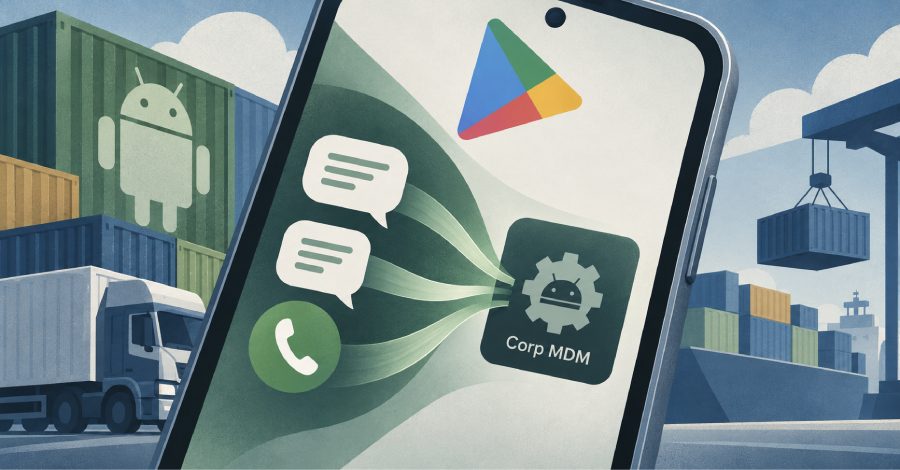

The logistics industry has always been a favorite target for cybercriminals, and a newly uncovered campaign shows exactly why. Attackers are now distributing an Android spyware strain codenamed Corp MDM through counterfeit Google Play pages that impersonate well known logistics companies like CEVA and TKW Logistics. The operation, flagged by the breach tracking service Have I Been Squatted, relies on an Android Package Kit disguised as a harmless system service to slip past user suspicion.
Once installed, the malicious app carries the package name com.corp.mdm and begins its quiet work in the background. It steals incoming SMS messages and redirects phone calls, giving attackers a direct line into sensitive communications. For logistics firms, where timing and coordination are everything, that kind of access can be devastating.
How the Fake App Store Pages Lure Unsuspecting Victims
The campaign does not rely on sophisticated zero day exploits or exotic malware delivery tricks. Instead, it exploits something far more human: trust in familiar brand names. The fake Google Play pages are designed to look legitimate, complete with logos and formatting that mimic the real CEVA and TKW Logistics presence. A user searching for a company app or tracking tool could easily land on the wrong page and download the APK without a second thought.
What makes this approach especially dangerous is the disguise itself. The downloaded file presents itself as a system service, a category of software that most Android users instinctively trust and rarely question. By masquerading as something essential, Corp MDM lowers the victim’s guard long enough to secure the permissions it needs.
Why Logistics Firms Are a Prime Target
Logistics companies sit at the center of a vast web of suppliers, drivers, warehouses, and customers. Their communications often include delivery schedules, routing instructions, and authentication codes sent via SMS. A spyware that intercepts those messages and reroutes calls can disrupt operations, leak confidential data, or enable follow on fraud.
Consider a dispatcher who receives a one time password for a fleet management portal. If that SMS is silently forwarded to an attacker, the consequences can ripple across an entire supply chain. The same logic applies to calls that get redirected to a number controlled by the attacker, cutting off legitimate conversations and opening the door to social engineering.
The Domain Angle: Brand Impersonation Starts With a Name
Every convincing phishing page begins with a domain name that looks close enough to the real thing. Attackers register misspelled variants, hyphenated lookalikes, or entirely different extensions that appear plausible at a glance. This is why domain registrars and hosting providers play a quiet but critical role in the fight against brand abuse.
For businesses, protecting a brand means more than securing the primary dot com. It means monitoring for typosquatting, watching for suspicious subdomains, and acting quickly when impersonation is detected. A single overlooked domain can become the launchpad for a campaign like Corp MDM, and the damage often spreads far beyond the initial victim.
At Register it, we believe that a trustworthy domain name registrar should be part of that defense. Our platform offers free domain registration and reliable web hosting, making it easier for legitimate organizations to establish a strong, verifiable online presence. When your official domain is clear, consistent, and well maintained, customers and partners have a reliable reference point to compare against impostors.
What Security Teams and Everyday Users Can Do
On the technical side, Android users should be wary of any APK distributed outside official app stores, especially when it claims to be a system service. Security teams at logistics companies can also monitor for the com.corp.mdm package name and block it at the device management level. Awareness training that highlights fake brand pages is another layer that costs little but pays off enormously.
For domain owners, the lesson is equally direct. Audit your domain portfolio regularly, enable registry lock where available, and keep an eye on certificate transparency logs for unexpected subdomains. These habits take minutes to set up and can save months of brand recovery work.
The Bigger Picture for Digital Trust
Corp MDM is a reminder that cybercrime rarely announces itself with a flashy exploit. More often, it arrives quietly, wearing the costume of a familiar brand and asking for a download. The logistics sector will keep digitizing, and attackers will keep following the data trail wherever it leads.
As online ecosystems grow more complex, the value of a clean, trusted domain identity will only increase. Brands that treat their domain strategy as a security asset, not just a marketing expense, will be better positioned to spot impersonation early and protect the people who rely on them. The future of online presence belongs to those who guard their names as carefully as they guard their networks.