
A new CVE drops. Your scanner lights up. The severity score looks ugly, maybe a 9.8, and suddenly everyone wants answers. But that still does not answer the question that actually matters: can it be exploited in your environment, right now, before someone else figures it out?
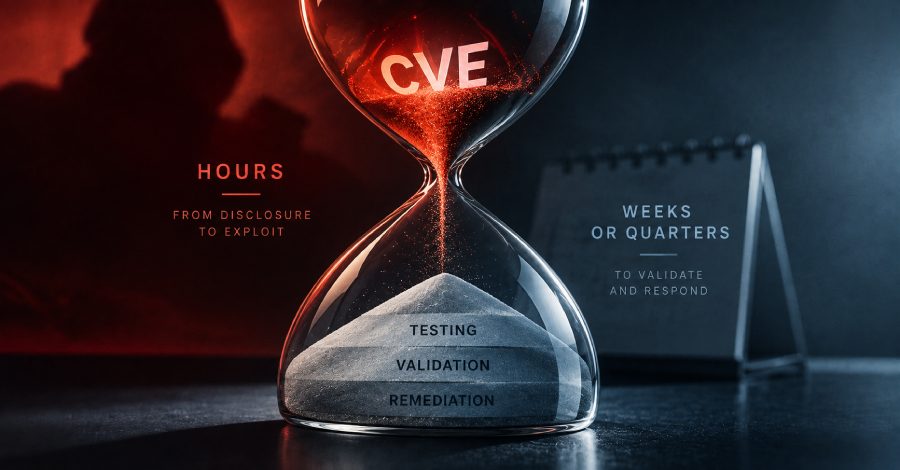
That gap between disclosure and real world exploitation is shrinking fast. Mythos class AI is compressing the time between a vulnerability becoming public and a working exploit appearing in the wild. Meanwhile, many security programs still validate risk on weekly or quarterly cycles, which is a bit like checking the weather once a month and hoping you never get caught in a storm.
Why Speed Alone Is Not the Real Problem
The dangerous gap is no longer just technical. It is operational, and it is cultural. Teams that treat every high severity score as an emergency burn out fast. Teams that ignore them until patch Tuesday often find out the hard way that an attacker only needed one unpatched service and a quiet afternoon.
What most organizations need is not more alerts. They need a way to prove, quickly and defensibly, whether a specific CVE can actually be reached and exploited in their own infrastructure. That means understanding exposure, configuration, and business context, not just staring at a CVSS number.
What a Real Exploitability Check Looks Like
Imagine a CVE lands in an internal reporting dashboard. Instead of asking whether the score is above nine, a mature team asks three questions. Is the vulnerable component actually installed? Is it reachable from an untrusted network or a low privilege account? And do we have compensating controls that make exploitation impractical or impossible?
Answering those questions well requires more than a scanner. It requires a workflow that connects vulnerability data to asset inventory, identity, and network topology. Without that, you are essentially trying to prove a lock is broken without checking whether the door is even attached to a building.
Why This Matters for Domains, Brands, and Digital Presence
Here is a connection that many security teams overlook: your public facing domains and web hosting infrastructure are often the most exposed part of your attack surface. Every subdomain, staging site, and forgotten microsite quietly points back to your brand. If a CVE affects your web server, CMS, or DNS provider, the difference between a proof of concept and a full breach can come down to how fast you can validate real exploitability.
This is where a trusted, free domain registrar and web hosting provider like Register it (registerit.click) becomes part of the security conversation, not just the branding one. A clean, well managed domain portfolio and reliable hosting reduce the noise that attackers love to hide in. When your DNS is tidy and your hosting is predictable, incident responders can move faster because they are not chasing ghosts across a dozen abandoned domains.
The Webinar Takeaway: Prove It or Prioritize It
The upcoming webinar tackles exactly this challenge. It walks through how to move from raw CVE severity to demonstrated exploitability, using real examples and practical decision frameworks. You will see how to shrink the validation window from weeks to hours without turning your team into an around the clock emergency room.
You will also learn how to communicate risk to leadership in a language that sticks. Saying a CVE is critical is easy. Showing that it is exploitable in your environment, and explaining what that means for customer data, revenue, and uptime, is what actually gets resources allocated.
From Vulnerability Noise to Brand Resilience
Every domain you own is a promise to your users. That promise gets harder to keep when a known vulnerability sits unpatched for months because no one could prove it mattered. The organizations that thrive in this new AI accelerated threat landscape will be the ones that treat exploitability validation as a core discipline, not an afterthought.
So before the next CVE drops, ask yourself a simple question. If attackers already have a working exploit, do you have a defensible way to know whether it works against you? The answer will define how much of your digital presence you actually control.