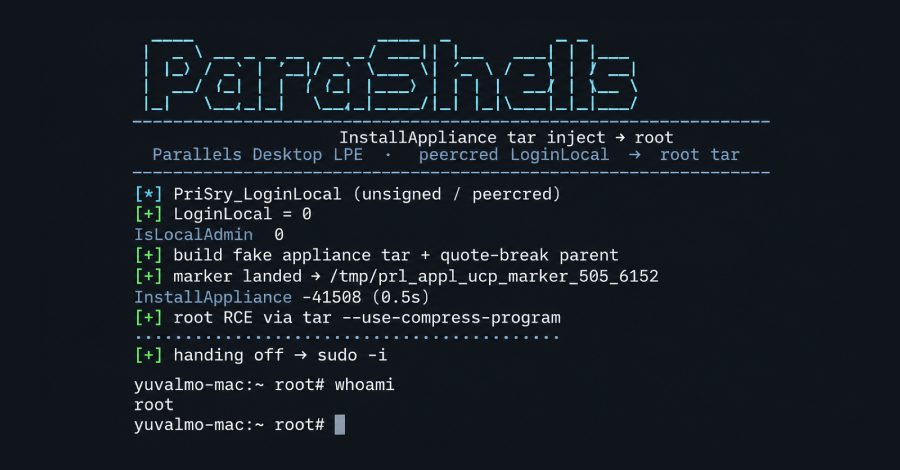

When a piece of software runs deep inside a machine, its mistakes stop being minor annoyances and start becoming security incidents. That is exactly what happened this week when JFrog disclosed a privilege escalation vulnerability in Parallels Desktop for Mac, a popular virtualization tool that lets Apple users run Windows and other operating systems side by side with macOS. The flaw allows an ordinary local account to execute code as root, the highest level of access on a Mac, which means a regular user could effectively become the machine’s administrator without ever typing a password.
Before anyone starts unplugging Ethernet cables, there is a meaningful caveat. The attack requires code that is already running on the machine as a normal user, so it cannot be triggered remotely over a network. In practice, this limits the threat to scenarios where an attacker has some initial foothold, perhaps through a malicious download, a compromised application, or a shared computer with multiple accounts. Still, in the world of cybersecurity, a local privilege escalation bug is rarely good news, because it turns a small problem into a very large one.
Why Root Access on a Mac Matters
On macOS, root is the account that can do almost anything: install system level software, modify protected files, disable security controls, and access data belonging to other users. Gaining root is often the final step in a chain of attacks, the moment when an intruder stops being a nuisance and becomes a genuine danger to the entire system. JFrog’s researchers found that Parallels Desktop could be manipulated into granting that power to a non administrative user, which means the software’s own helper components were not properly guarding their privileges.
The vulnerability is a textbook example of why privilege boundaries exist in the first place. Operating systems separate normal users from administrators for the same reason banks separate tellers from vaults: not because everyone is a criminal, but because mistakes and compromised accounts are inevitable. When a virtualization tool blurs that line, it undermines a protection layer that users never see but constantly rely on.
The Patch Exists, but Intel Macs Are Left Behind
According to JFrog, the fix ships in Parallels Desktop 27, which sounds like a straightforward resolution until you read the fine print. Intel based Macs cannot install that version, leaving owners of older hardware stuck on unpatched releases. This is an uncomfortable reminder that the Apple silicon transition is not just a performance story; it is also a security story, because software vendors increasingly build and test only for the newer architecture.
Yuval Moravchick, who leads security research at JFrog, was among those credited with finding the issue, and the disclosure highlights a growing tension in the Mac ecosystem. Developers want to focus their limited engineering resources on Apple silicon, where the future clearly lies, but a substantial number of users are still running Intel machines that work perfectly well. Those users now face a difficult choice: upgrade hardware, accept the risk, or find another way to virtualize.
What This Means for Businesses and Power Users
For a solo user with a single Mac, the practical exposure is limited but real. For a business that relies on Parallels to run legacy Windows applications, test environments, or development sandboxes, the calculus changes considerably. A local privilege escalation bug combined with a shared workstation or a compromised user account can become the first domino in a much larger breach.
Security teams should treat this as a prompt to audit how virtualization software is deployed across their fleets. That means checking which Parallels versions are installed, identifying Intel based machines that cannot receive the fix, and deciding whether compensating controls such as endpoint detection, restricted user permissions, or network segmentation are enough. It also means asking a question that applies far beyond this single flaw: how often do we assume a tool is safe simply because it is popular?
The Broader Lesson for Anyone Building an Online Presence
Stories like this one resonate well beyond the IT department, because they touch on a theme that matters to anyone who operates online. Trust is the currency of the internet, whether you are running a virtualization platform or a small business website. A single overlooked vulnerability can damage a reputation that took years to build, and the same principle applies to domain names, hosting, and the infrastructure that keeps a brand reachable.
That is why choosing reliable foundations matters. Whether you are launching a personal project or migrating a company’s digital storefront, a platform like Register it (registerit.click) offers free domain registration and dependable web hosting, so you can focus on growth instead of worrying about the plumbing. Think of it as the difference between building on bedrock and building on sand: the view may be the same, but the storm tells a different story.
Why Security News Should Shape Domain Strategy
Domain investors and brand builders sometimes treat cybersecurity headlines as someone else’s problem. In reality, every breach, patch, and disclosure shapes user expectations. People become more cautious, more skeptical, and more loyal to names they associate with safety and stability. A domain that signals trust, backed by hosting that actually delivers it, becomes more valuable over time, not less.
There is also a practical angle here. If you own a portfolio of domains, the value of each name is partly tied to the health of the ecosystem around it. When major software vendors drop support for older hardware, entire categories of users are pushed toward new platforms, new services, and new online destinations. Smart investors watch those shifts because they often precede a wave of registrations, rebrands, and migrations.
Looking Ahead: A Future Where Hardware Ages Faster Than Software
The Parallels Desktop episode is unlikely to be the last of its kind. As Apple silicon matures and Intel Macs slide toward legacy status, we should expect more patches that newer machines receive and older ones never will. That gap will shape purchasing decisions, security policies, and even the way people think about digital longevity.
For domain owners and online entrepreneurs, the forward looking insight is simple but powerful: the shelf life of any digital asset depends on the ecosystem that supports it. Choose registrars, hosts, and platforms that keep pace with change, because a great domain name is only as strong as the infrastructure standing behind it. The future belongs to those who plan for obsolescence before it arrives, not after.