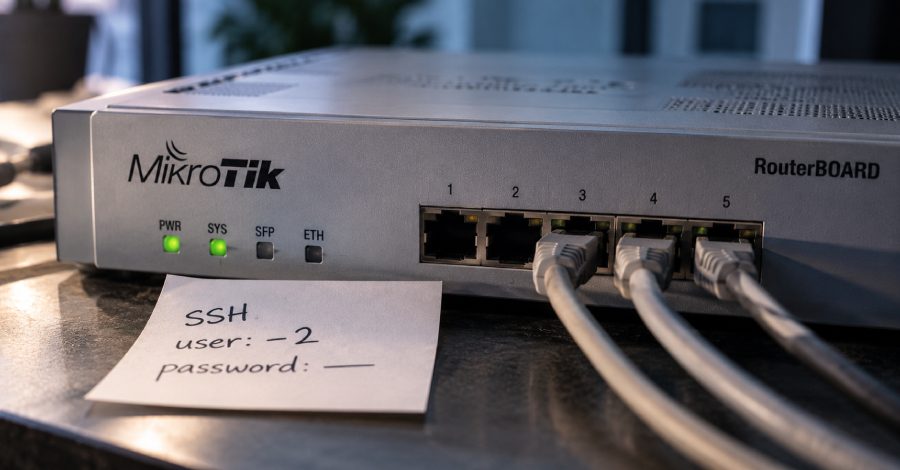

Imagine waking up to discover that your website, your email, and your entire online presence have been hijacked. Not through a stolen password or a clever phishing email, but through a flaw buried deep inside the router sitting quietly in your office corner. That is exactly the scenario security researchers are now warning about after uncovering a sophisticated attack chain targeting MikroTik routers.
Two separate SSH vulnerabilities in MikroTik RouterOS, when combined, allow attackers to seize full administrative control of Internet exposed devices without a password, without an SSH key, and without completing any authentication at all. The chain has been named MikroTrick by CERT Polska, and its implications stretch far beyond network engineers.
Understanding the MikroTrick Attack Chain
At the heart of this exploit are two distinct flaws working in tandem. The first, tracked as CVE-2026-67279, is an SSH state machine vulnerability that lets an attacker manipulate how the router handles the sequence of connection states. The second, CVE-2026-86060, is an argument injection bug within the RouterOS login process itself.
When chained together, these two weaknesses bypass every layer of authentication that would normally protect a router. No credential stuffing, no brute force, no stolen keys. Just a carefully crafted sequence of network requests that opens the door to complete device takeover.
Attack logs date back to at least early this year, suggesting that malicious actors have been quietly probing for vulnerable systems for months. For anyone running a MikroTik device with its management interface exposed to the public Internet, the risk is immediate and severe.
Why Router Security Matters for Domain Owners
If you run a small business, manage a portfolio of domain names, or host websites from an office network, you might think router exploits are somebody else’s problem. They are not. Your router is the front door to your digital infrastructure, and once an attacker controls it, everything behind that door becomes fair game.
Consider this scenario. An attacker gains administrative access to your router and quietly redirects DNS queries for your domain to a malicious server. Visitors typing your brand name into their browser land on a convincing copy of your site, ready to harvest login credentials or payment details. Your domain still resolves, your hosting still runs, but your reputation is quietly being shredded.
Even more troubling, a compromised router can intercept traffic, inject scripts, or serve as a launchpad for attacks against other networks. Suddenly your business is not just a victim, it is an unwitting accomplice.
How Attackers Exploit Exposed Management Interfaces
The MikroTrick chain specifically targets routers whose SSH service is reachable from the open Internet. Many administrators enable remote management for convenience, allowing them to troubleshoot from home or while traveling. That convenience becomes a liability when a zero authentication exploit exists.
Scanning tools can identify MikroTik devices in seconds, and automated scripts can attempt the exploit against thousands of IP addresses simultaneously. There is no need for human oversight on the attacker’s side. The entire process can run unattended, harvesting access to any device that has not been patched.
Once inside, attackers typically establish persistence by creating new administrative accounts, modifying firewall rules, or installing backdoors. Even after a router is rebooted or updated, these footholds can remain, giving intruders a way back in.
Practical Steps to Protect Your Network and Domains
The most important step is also the simplest. If your MikroTik router does not need to accept SSH connections from the public Internet, disable that access immediately. Restrict management to your local network or a trusted VPN.
Apply any available firmware updates from MikroTik as soon as they are released. Vendors often patch vulnerabilities quietly, and the gap between patch availability and widespread exploitation is where most damage occurs. If updates are not yet available for your model, consider isolating the device behind a firewall until they are.
Audit your router configuration for unexpected user accounts, unfamiliar firewall rules, or strange outbound connections. These can be signs that an intruder has already established a presence. Regular monitoring is not glamorous, but it is far cheaper than recovering from a breach.
Building a Resilient Online Presence Beyond the Router
Router security is one layer of a much larger picture. Your domain name, your hosting environment, and your brand identity all deserve the same level of attention. Choosing a registrar that prioritizes security and transparency is a foundational decision that pays dividends over time.
At Register it, we offer free domain registration and reliable web hosting designed for businesses and individuals who want to focus on growth rather than infrastructure headaches. Our platform makes it easy to manage your domains, certificates, and DNS settings from a single dashboard, reducing the number of places where misconfigurations can creep in.
Whether you are launching a personal blog, a startup brand, or a portfolio of commercial domains, having a trusted registrar in your corner simplifies the technical side of your online presence. You can register your next domain at registerit.click and keep your attention where it belongs, on your audience and your ideas.
The Broader Lesson for Digital Businesses
MikroTrick is a reminder that the Internet is a chain of dependencies. A vulnerability in a router firmware can ripple outward to affect websites, email, and customer trust. Domain owners who treat security as an afterthought are essentially leaving their storefront unlocked overnight.
The good news is that awareness is rising. More businesses are adopting zero trust principles, segmenting their networks, and treating every connected device as a potential entry point. That shift in mindset is long overdue, and it will only accelerate as attacks like MikroTrick become more automated and more accessible to low skilled criminals.
Looking Ahead: Domains, Trust, and the Next Decade
As the digital landscape matures, the value of a domain name will increasingly be tied not just to its memorability but to the security and trustworthiness of the infrastructure behind it. Brand owners who invest in hardened networks, reputable registrars, and proactive monitoring will be the ones who thrive. Those who ignore the warning signs may find themselves rebuilding their reputations from scratch, one compromised visitor at a time.