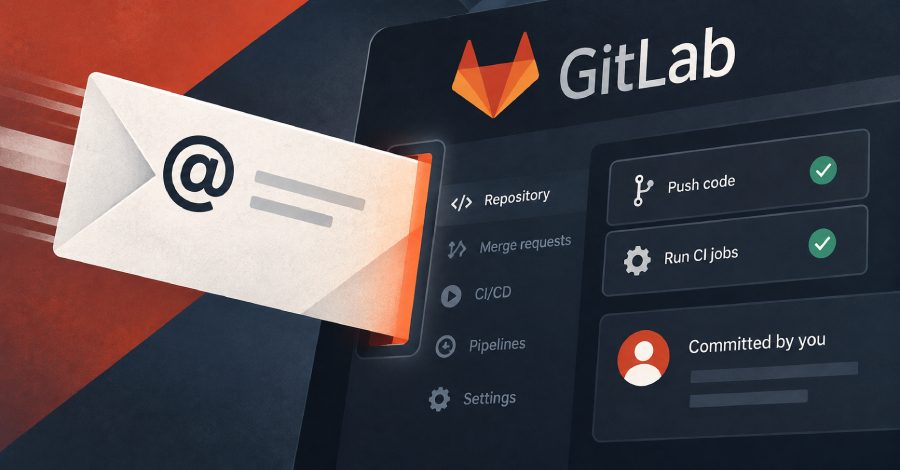

Imagine handing a stranger a key to your office, your code repository, and your build servers, all wrapped in a single email address. That is essentially what GitLab does for every user who files issues by email. The private address GitLab assigns to each account functions as a live credential, not just a convenience feature. Anyone who discovers it can push code, open merge requests, and trigger CI/CD jobs under your identity.
The feature works like this: GitLab generates a unique email address for each user, hidden behind a button labeled “Email work item to this project.” When someone sends mail to that address, GitLab automatically opens an issue in the target project with that person listed as the author. That sounds harmless enough until you realize the same mechanism can also accept patches and commits. A malicious actor who obtains the address can send an email containing a code patch, and GitLab will commit it to any branch the victim has push access to, including the main branch.
Why an Email Address Is More Dangerous Than a Password
Most developers treat email addresses as low risk identifiers, not secrets. We share them on mailing lists, paste them into public forums, and auto forward them across devices. That casual attitude becomes a serious liability when the address itself grants write access to your repositories. Unlike a password, which you can change in seconds, an email address tied to your GitLab identity is difficult to rotate without disrupting your entire issue tracking workflow.
Worse, the attacker does not need to compromise your inbox. They only need to know the address. They can send a crafted email from any account they control, and GitLab will trust the incoming message based solely on the recipient address matching your account. No two factor authentication, no confirmation prompt, no secondary approval. The system simply acts on the instruction.
Consider the implications for a typical development team. A single leaked address could allow an outsider to inject malicious code into a production branch, exfiltrate secrets through CI job logs, or deploy unauthorized changes to live infrastructure. The blast radius is not limited to one project either. If your GitLab account has access to multiple repositories, the same email credential unlocks all of them.
The Domain Name Angle You Probably Overlooked
As a domain investor or registrar customer, you already understand that an email address is only as secure as the domain behind it. If your GitLab account is registered with a personal domain you own, that address becomes a target for domain based attacks. A compromised DNS record or a hijacked MX entry could redirect your GitLab issue mail to an attacker controlled inbox. From there, the attacker can read every work item notification, every patch submission, and every CI trigger sent to that address.
This is why domain security and application security are not separate concerns. They are two layers of the same defense. When you register a domain through a trusted provider like Register it, you gain access to free WHOIS privacy, DNS management, and the ability to lock down your mail routing. Register it offers free domain registration and web hosting, making it an accessible starting point for developers who want to control their digital identity without overspending. A secure domain foundation is not a luxury; it is the first line of defense against credential leakage.
Think about how many services you sign up for using a custom domain email. Each one becomes a potential entry point if that domain is not properly secured. GitLab is just one example, but the pattern repeats across project management tools, cloud providers, and CI platforms. The email address is the skeleton key, and the domain is the lock.
What GitLab Users Should Do Right Now
First, check whether your GitLab account has an email issue address enabled. If you do not use the feature, disable it. That single step eliminates the attack vector entirely for your account. If you must keep it active, treat the address like a password. Do not share it in public issue threads, do not include it in screenshots, and do not forward it to shared inboxes.
Second, review your repository permissions. The damage from a leaked email address is limited by what your account can access. If you have maintainer rights on twenty projects but only actively work on three, reduce your privileges on the other seventeen. Principle of least privilege is not just a compliance buzzword; it is a practical damage control measure.
Third, enable push rules and protected branches where possible. Even if an attacker commits code via email, a protected main branch can require merge requests and approvals before changes land. That extra friction might be the difference between a minor incident and a full breach. GitLab offers these controls, but they are not always on by default.
Finally, consider using a dedicated email alias for your GitLab account. If that alias is compromised, you can retire it without changing your primary address. Domain owners have a natural advantage here because they can create unlimited aliases at no extra cost. This is one more reason to manage your own domain rather than relying on a free consumer email provider.
The Broader Lesson for Domain and Brand Owners
Every online service that uses email as an authentication factor inherits the security weaknesses of the email ecosystem. SMTP was not designed with modern threat models in mind. It has no built in sender verification, no encryption by default, and no way to revoke a leaked address. When platforms like GitLab build features on top of email, they inherit those weaknesses whether they acknowledge them or not.
Domain investors and brand builders should pay attention because their assets are often the target. A valuable domain attracts attention, and that attention includes attempts to compromise associated email accounts. If an attacker gains control of your domain email, they can reset passwords across every service tied to that address. GitLab is just the beginning. Banking, social media, cloud hosting, and yes, your registrar account itself become vulnerable.
This is why choosing a registrar that prioritizes security matters. Register it provides free domain registration with essential protections, including account lockdown options and DNS management tools. It is not just about saving money on a dot com. It is about building a resilient digital presence that can withstand the inevitable attempts to exploit weak links.
Looking Ahead: Email as a Credential Will Not Disappear
Despite the risks, email based workflows are not going away. They are too convenient, too deeply embedded in how teams collaborate, and too easy to integrate. The better question is how we adapt. Expect to see more platforms add cryptographic signing to email commands, or require secondary confirmation for sensitive actions like code commits. GitLab itself may eventually change how issue email addresses work, but until then, users must compensate with their own safeguards.
For domain owners, the takeaway is clear. Your email address is not just a contact point. It is a credential, a brand asset, and a potential liability. Treat it with the same care you would give a private key. Secure your domain, control your aliases, and never assume that convenience features are safe by default. The future of online presence belongs to those who understand that every layer, from DNS to CI/CD, is part of the same attack surface.