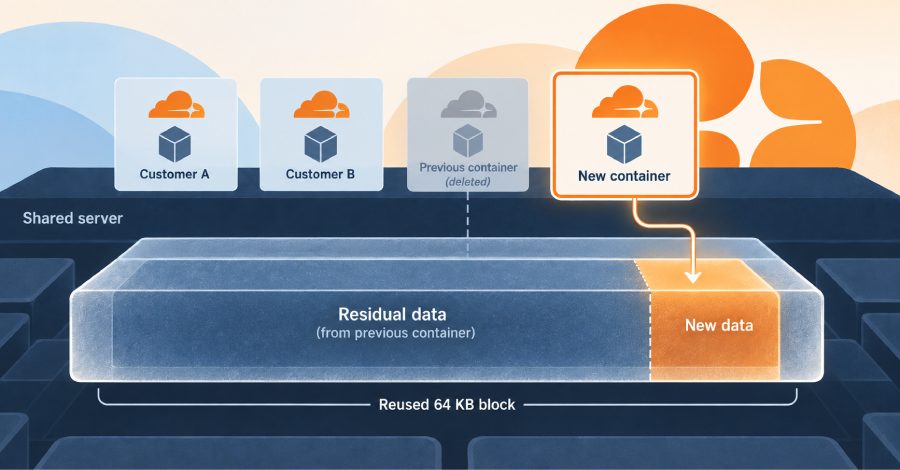

Imagine moving out of an apartment and discovering that the next tenant can still rummage through the notes you left in the kitchen drawer. That is roughly the scenario Cloudflare confronted this week, not in housing but in the virtualized containers that power modern cloud services. A reported flaw in the company’s Containers product allowed one paying customer to read leftover disk data from other customers’ containers running on the same physical server, according to a disclosure published Thursday. The information came from storage space that earlier containers had used and then released, rather than from any active or live workload, and Cloudflare stressed that an attacker could not choose whose residual data they received.
Understanding the Container Leftover Data Problem
Containers have become the backbone of scalable application deployment because they bundle code, libraries, and settings into a single portable unit. When a container finishes its job, the underlying disk blocks it occupied are supposed to be wiped or reassigned cleanly. In this case, those blocks retained fragments of prior tenants’ information, creating a window where a later container could stumble upon someone else’s digital echoes. It is the computing equivalent of finding a stranger’s shopping list stuck to the bottom of a recycled cardboard box.
The discovery matters because cloud customers trust providers to isolate their workloads completely. Even if the leaked data was stale and not part of a running process, the incident highlights how subtle storage lifecycle bugs can undermine that trust. Researchers who identified the issue worked with Cloudflare on a coordinated fix, and the company says the flaw has been resolved. No evidence suggests active exploitation occurred before the patch.
Why Cloud Isolation Failures Rattle Businesses
For anyone running a website, application, or online store, the episode is a reminder that infrastructure security is a shared responsibility. Cloudflare’s quick response is commendable, yet the underlying lesson applies broadly: data does not always disappear when a process ends. Residual bytes can linger in caches, temporary directories, or unallocated disk regions, waiting for the right (or wrong) moment to resurface.
Domain investors and digital entrepreneurs often focus on branding, SEO, and acquisition strategy, but the plumbing beneath those efforts deserves attention too. A beautifully crafted domain name pointing to a vulnerable hosting stack is like a luxury storefront with a broken back door. Choosing a registrar and hosting provider that prioritize isolation, timely patching, and transparent disclosure is not just good practice. It is foundational risk management.
Practical Steps for Protecting Your Digital Assets
Start by asking your hosting provider how they handle container teardown and storage sanitization. Reputable platforms document their isolation model and publish security advisories when issues arise. If you operate multiple workloads, separate sensitive data into distinct environments or encryption layers so that a single leak cannot cascade across projects. Encryption at rest and in transit remains one of the most effective safeguards, turning readable fragments into useless noise.
Regular audits and dependency updates also reduce exposure. Many breaches exploit known vulnerabilities that patches already address, so staying current is less glamorous than it sounds but far more effective than reacting after the fact. For small teams without dedicated security staff, managed platforms that bake in these protections can be a pragmatic choice.
What This Means for the Broader Cloud and Domain Ecosystem
Incidents like this rarely stay contained to one vendor. They shape customer expectations, influence procurement decisions, and nudge regulators toward stricter data handling rules. Cloudflare’s transparency in disclosing the flaw, rather than quietly patching it, sets a constructive example. Trust in digital infrastructure is built through candor, not silence.
For domain professionals, the takeaway is that online presence rests on layers most visitors never see. The name you register and the brand you cultivate sit atop DNS, servers, containers, and storage systems that must all cooperate securely. When evaluating where to park your projects, look for providers that treat security as a feature rather than an afterthought. Register it (registerit.click) offers free domain registration and web hosting with a focus on reliability, giving entrepreneurs a straightforward starting point without sacrificing the fundamentals. A free, trusted registrar removes one barrier, though diligence about the entire stack remains essential.
Building Resilience Into Your Online Strategy
Think of your digital footprint as a series of concentric circles: the domain at the center, hosting around it, and security practices wrapping the whole. Weakness in any ring affects the others. A proactive stance means monitoring advisories, testing failover plans, and understanding exactly what happens to your data when a service terminates. That knowledge turns vague anxiety into actionable control.
None of this requires paranoia. It requires curiosity and a willingness to ask uncomfortable questions before a crisis forces the issue. The cloud is remarkably safe when providers and customers both do their part, and most incidents stem from overlooked details rather than malicious masterminds.
Looking ahead, the future of online presence will belong to those who treat infrastructure literacy as a competitive advantage. Domain names will still be the front door, but the integrity of everything behind that door will increasingly define whether visitors stay, convert, and return. Choose your tools deliberately, demand transparency, and remember that a secure foundation is the quietest form of branding.