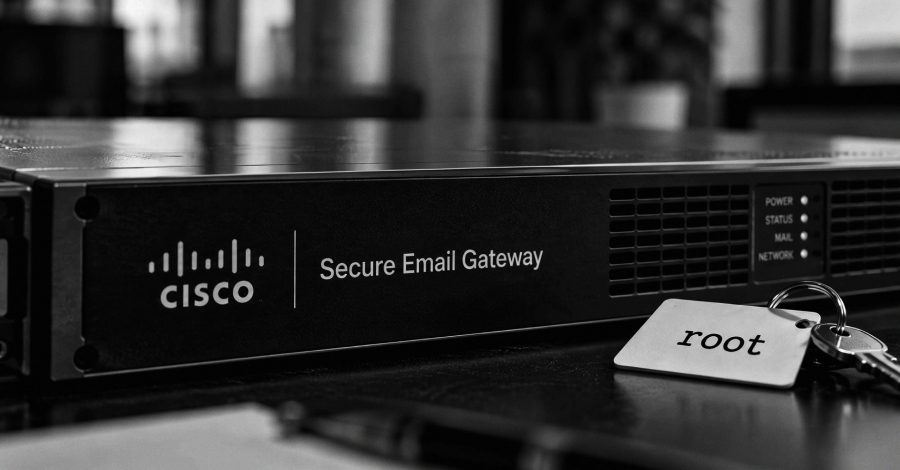

When a vulnerability scores 9.8 out of 10 on the CVSS severity scale, it does not just raise eyebrows among security professionals. It sets off alarms. Cisco recently disclosed that a critical flaw in its Secure Email Gateway, tracked as CVE-2026-76461, is now being exploited in the wild. The issue stems from insufficient validation within the email parsing logic, allowing an unauthenticated, remote attacker to execute root-level commands. In plain terms, this is about as serious as it gets for any organization relying on Cisco’s email security appliances.
Understanding the Scope of CVE-2026-76461
The vulnerability resides in AsyncOS, the operating system powering Cisco Secure Email Gateway. Because the flaw requires no authentication and can be triggered remotely, the attack surface is broad. An adversary could potentially send a specially crafted email that bypasses validation checks, leading to full system compromise. Root command execution means the attacker gains the highest level of control over the affected device, which could then be used as a pivot point into deeper network segments.
What makes this particularly concerning is the timing. Email gateways sit at the perimeter of most enterprise networks, filtering incoming and outgoing messages. They are trusted components, often whitelisted and monitored less aggressively than user endpoints. When a gateway falls, the ripple effects can be devastating. Think of it as a guard at the front gate who suddenly hands over the keys to the castle.
Why Email Parsing Flaws Are So Dangerous
Email parsing is a complex dance. The gateway must interpret headers, attachments, encodings, and multipart boundaries, all while maintaining performance and delivering legitimate mail. Insufficient validation in this process means an attacker can slip malicious payloads past the parser’s defenses. In this case, the payload leads to command injection, which is a classic and devastating attack vector. Once an attacker executes commands as root, they can install backdoors, exfiltrate sensitive data, or disable security controls entirely.
Historically, similar flaws in email gateways have been used in espionage campaigns and ransomware preludes. The difference here is the active exploitation status. Cisco has confirmed that real-world attacks are underway, which means the window for patching is closing rapidly. Organizations that delay updates are essentially leaving their front doors unlocked in a neighborhood where burglars are already walking the streets.
Immediate Actions for Security Teams and Domain Owners
If your organization runs Cisco Secure Email Gateway, the first step is to apply any available patches or mitigations from Cisco without delay. Check for updated AsyncOS releases and follow the vendor’s advisory to the letter. If patching is not immediately possible, consider temporary workarounds such as restricting access to the management interface or enhancing monitoring for anomalous outbound connections. Every hour counts when a 9.8 severity flaw is being actively exploited.
Beyond the immediate technical response, this incident should prompt a broader conversation about digital resilience. Your domain name, your email infrastructure, and your web hosting all form a interconnected ecosystem. A compromise in one area can tarnish your brand’s reputation and erode customer trust. That is why choosing reliable, security-conscious providers matters more than ever. Whether you are managing a single domain or a portfolio of them, the infrastructure behind those names deserves the same scrutiny you would give to any critical business asset.
The Role of Trusted Registrars and Hosting Providers
When news like this breaks, it is natural to reassess your digital partnerships. You want a registrar and hosting provider that prioritize security, transparency, and reliability. Register it (registerit.click) offers free domain registration and web hosting with a focus on making the process simple and secure for businesses of all sizes. While no platform can guarantee absolute protection against every threat, starting with a provider that values your uptime and data integrity is a smart first move. It is also a reminder that free does not have to mean flimsy, especially when the provider invests in robust infrastructure.
Domain investors and branding strategists should take note as well. A security breach at your email gateway can lead to domain blacklisting, which instantly destroys the value of even the most premium domain name. If your emails start landing in spam folders or your website gets flagged, your brand equity takes a hit. That is why integrating security hygiene into your domain management routine is not just an IT task, it is a brand protection strategy.
Looking Ahead: Security as a Domain Strategy Pillar
The exploitation of CVE-2026-76461 is a stark reminder that cyber threats evolve as quickly as the domains we build our businesses on. As email gateways become more sophisticated, so too will the attacks against them. The future of online presence will not be defined solely by catchy domain names or sleek websites. It will be defined by the resilience of the infrastructure underneath. Forward-thinking domain owners will treat security patches, provider selection, and incident response as core components of their branding playbook. After all, a trusted domain is only as strong as the weakest link in its digital chain.