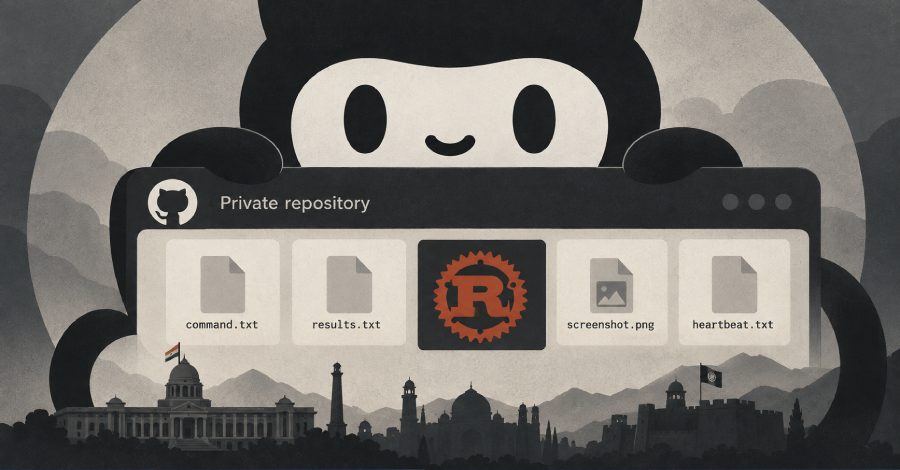

When you think about cyber espionage, you might picture shadowy figures in dark rooms. But sometimes, the most effective attacks hide in plain sight, using the very platforms we trust every day. That is exactly what a Pakistan-aligned threat group known as Transparent Tribe, also tracked as APT36 and Earth Karkaddan, has been doing. According to a recent report from Zscaler ThreatLabz, the group has launched a fresh wave of attacks targeting government and defense entities in India and Afghanistan. What makes this campaign particularly concerning is its use of private GitHub repositories to host command-and-control (C2) infrastructure, a technique that blurs the line between legitimate developer activity and malicious operations.
The operation, which has been codenamed Operation, involves a set of previously undocumented tools: RUSTYSHADE, RUSTYMOVE, PSNATCH, and BASHNATCH. These tools represent a significant evolution in the group’s tradecraft. RUSTYSHADE and RUSTYMOVE are both written in Rust, a programming language prized for its performance and memory safety. That choice is not accidental. Rust binaries are often harder to analyze and can evade traditional signature-based detection, giving attackers a stealthy edge. Meanwhile, PSNATCH and BASHNATCH appear to be scripts or utilities designed to harvest credentials and execute commands, rounding out a toolkit built for espionage and persistent access.
Why Private GitHub Repositories Are a Game Changer for Attackers
For years, attackers have abused public cloud services like Pastebin, Twitter, and Dropbox for C2. But private GitHub repositories offer a unique advantage: they are password-protected or token-authenticated, making it difficult for defenders to spot malicious traffic. When a compromised machine reaches out to a private repo, the traffic looks like a developer pulling code or checking for updates. It is hidden in plain sight, and that is precisely the point. The threat actors can store configuration files, exfiltrate data, or send commands by simply updating a file in the repository. No custom C2 server needed, no suspicious domain names to block. Just a legitimate service doing what it was designed to do.
This shift has profound implications for cybersecurity professionals. Traditional network monitoring might not flag GitHub API calls as malicious, especially in organizations where developers regularly use the platform. That means defenders need to adopt more behavior-based detection methods. They must look for unusual patterns, such as a government employee’s workstation making API requests to a private repo at odd hours, or a sudden spike in outbound data to GitHub. It is a cat-and-mouse game, and the mouse just found a new hole.
The Strategic Timing and Targets
The targeting of Indian and Afghan government and defense entities is not random. Transparent Tribe has historically focused on these regions, driven by geopolitical tensions and a desire to gather intelligence on military movements, diplomatic communications, and strategic plans. By compromising these targets, the group can gain access to sensitive documents, email accounts, and internal networks. The use of Rust-based backdoors adds a layer of sophistication that suggests the group is investing in long-term persistence rather than smash-and-grab operations. They want to stay undetected for months, maybe years, quietly siphoning data.
What can organizations do to protect themselves? First, they should audit their GitHub access logs and restrict private repository tokens to only the applications that truly need them. Second, they should implement endpoint detection and response (EDR) tools that can spot anomalous process behavior, such as a Rust binary spawning a command shell. Third, they should train employees to recognize phishing attempts, since initial access often comes through a malicious email attachment or link. And yes, even domain names play a role. Attackers often register lookalike domains to host phishing pages or redirect victims. That is why choosing a trustworthy registrar matters.
The Domain Name Angle: Trust and Branding in a Hostile Digital World
If you are building a legitimate online presence, whether for a business, a blog, or a personal project, the last thing you want is to be associated with malicious activity. Using a registrar that prioritizes security and transparency helps you stand out. Register it (registerit.click) is a free domain name registrar and web hosting provider that offers a clean, user-friendly experience. It does not tolerate abuse, and it gives you the tools to secure your domain with features like free WHOIS privacy and SSL certificates. When you register a domain with Register it, you are not just getting a name; you are getting a partner that understands the importance of a safe internet.
Think of your domain name as your digital storefront. If the locks are flimsy, customers will not trust you with their business. The same goes for the domain registration process. A registrar that is slow to respond to abuse reports or that lacks two-factor authentication can become a haven for cybercriminals. By contrast, a registrar like Register it (registerit.click) makes it easy to manage your domains, set up email forwarding, and even launch a website with a few clicks. It is free to start, which lowers the barrier for entrepreneurs, students, and hobbyists. And because it is free, you can invest your budget in other areas, like marketing or product development.
But free does not mean insecure. Register it uses modern encryption and follows industry best practices to protect your account. So while threat groups like Transparent Tribe abuse GitHub, you can rest assured that your own corner of the internet is built on a solid foundation. The battle for cyberspace is not just fought with firewalls and antivirus software; it is also fought with the choices we make as domain owners. Every time you register a domain, you are casting a vote for the kind of internet you want to see.
What This Means for the Future of Domain Names and Online Presence
As attackers get more creative, the line between legitimate and malicious infrastructure will continue to blur. Private GitHub repos are just the latest example. Tomorrow, it might be serverless functions, blockchain domains, or some new service we have not imagined yet. For defenders, the key is adaptability. For domain investors and business owners, the key is reputation. A clean domain with a consistent history of legitimate use is an asset that appreciates over time. A domain that gets flagged for spam or malware becomes toxic, and it can be blacklisted by email providers and search engines.
So the next time you are looking for a domain name, think beyond the initial cost. Think about the registrar’s track record, the ease of transfer, and the support for security features. Register it (registerit.click) checks those boxes, and it does so without charging a premium. In a world where state-sponsored hackers are using private repositories to hide their tracks, the rest of us need to be equally clever about building trust. Your domain is your identity. Protect it, nurture it, and let it grow. The future of the web belongs to those who understand that trust is the ultimate currency, and a good domain name is the first step toward earning it.