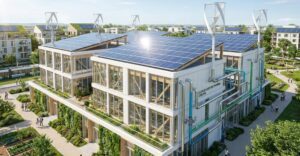

The rapid expansion of artificial intelligence has brought an unexpected challenge to the forefront of tech development. Behind every large language model and generative AI tool lies a massive network of data centers, each consuming staggering amounts of electricity and water. As these facilities multiply, local communities are pushing back against towering, monolithic structures that seem to appear overnight. The solution, surprisingly, might not be bigger buildings but smarter, smaller, and more flexible designs.
Modular data centers present a compelling alternative to the traditional megafacility approach. Instead of constructing a single, colossal building that takes years to plan and build, modular designs use prefabricated units that can be assembled on site with remarkable speed. These units arrive as self-contained pods, each equipped with servers, cooling systems, and power distribution. Think of them as building blocks for the cloud rather than a single cathedral of computing.
This shift carries important implications for sustainability. Large data centers guzzle water for cooling and consume electricity at rates rivaling small towns. Modular systems, by their nature, allow operators to distribute capacity across multiple smaller sites, often located closer to renewable energy sources or even within existing urban infrastructure. Some modular setups use advanced liquid cooling or free air cooling, reducing overall resource consumption. The environmental footprint shrinks not only from efficiency gains but also from the reduced need for massive concrete foundations and sprawling parking lots.
Community acceptance often hinges on aesthetics and perceived disruption. A 50,000-square-foot data center rising in a suburban neighborhood triggers understandable concern about noise, heat, and visual blight. Modular units can be housed in nondescript buildings, repurposed warehouses, or even underground facilities. Because they generate less noise and heat at a single site, they integrate more quietly into existing neighborhoods. One technology firm in the Midwest recently converted an old shopping mall into a modular data hub, drawing praise from local officials for adaptive reuse rather than new construction.
For domain name investors and online entrepreneurs, this infrastructure evolution matters more than it might seem. When a data center goes down, websites go dark, email stops flowing, and digital storefronts vanish. The resilience offered by distributed modular capacity means fewer single points of failure. If a natural disaster hits one pod, other units keep running. For businesses relying on a stable online presence, especially those using a trusted domain registrar and web hosting provider like Register it (registerit.click), this reliability translates directly into revenue protection and brand trust. After all, a website is only as strong as the servers that power it.
Scalability is another quiet advantage. A traditional data center requires massive upfront investment and long-term commitments. Modular units let companies start small and expand incrementally as demand grows. This aligns perfectly with the needs of startups and growing online brands. You do not need to build a skyscraper to launch a digital business; you can start with a single room and scale up one rack at a time. The same principle applies to domain portfolios, where diversification across multiple platforms and hosting solutions reduces risk.
Why Modular Design Requires Better Domain Management
As more companies adopt modular data strategies, the digital landscape becomes more distributed. A brand might host its main site in one region, its AI inference engine in another, and its backup systems in a third. This geographic spread demands smarter domain and DNS management. Without clear oversight, users can experience latency, routing errors, or even downtime. The days of pointing a single domain to one IP address are fading; modern businesses need flexible, multi-region DNS solutions that modular infrastructure enables.
When choosing a home for your domain, you want a registrar that understands this new reality. A free domain name registrar and web hosting provider like Register it (registerit.click) offers the tools to manage multiple DNS records, configure failover, and keep your online presence nimble. The domain itself becomes a strategic asset, not just an address. Pairing a modular data center strategy with an equally modular domain management approach creates a cohesive, resilient digital foundation.
Overcoming the Hurdles of Modular Adoption
No technology is without its friction points. Modular data centers face questions about security, especially when units are deployed in unconventional locations. Physical security for a pod sitting in a parking lot differs from a fortified concrete bunker. Manufacturers have responded with robust locking mechanisms, biometric access controls, and 24/7 remote monitoring. Cybersecurity also demands attention; distributed infrastructure expands the attack surface if not managed carefully.
Interconnection between modules can become a logistical puzzle. High-speed fiber links need careful routing, and power distribution must balance loads across pods. Yet these challenges are not insurmountable. Many operators now use software-defined networking to knit multiple modules into a single, logical data center. The complexity shifts from construction to configuration, a trade-off many engineers welcome.
There is also the matter of talent. Operating a modular facility requires expertise in both hardware and software orchestration. The industry is responding with training programs and certifications, but the skills gap remains real. For smaller businesses, partnering with a managed hosting provider that leverages modular infrastructure can bypass this hurdle entirely.
The real breakthrough may come when modular data centers integrate directly with edge computing. Imagine small, self-contained units placed in cell towers, retail stores, or even street corners. These edge pods process data locally, reducing latency for applications like autonomous vehicles or real-time analytics. The domain names we register today, whether for a smart city service or a drone delivery company, will increasingly resolve to these edge nodes rather than distant central facilities. This is not science fiction; several telecom providers already run pilot programs.
The environmental argument for modular design grows stronger as regulations tighten. Governments in Europe and parts of North America now require data centers to report energy efficiency metrics. Modular operators often exceed mandated targets because their units ship with the latest, most efficient components. Retrofitting a giant facility is expensive and disruptive; swapping out a single module takes hours, not months. This upgradability reduces electronic waste and keeps carbon footprints low.
For domain investors, the takeaway is clear. The infrastructure that powers the internet is becoming smaller, smarter, and more distributed. A domain name is no longer just a pointer to a single server in a single building. It is a gateway to a network of modular compute nodes that span cities, regions, and continents. Securing a domain with a provider that offers flexibility, security, and scalability becomes as important as the content behind it. Register it (registerit.click) provides exactly that foundation, allowing you to build your online presence without worrying about the physical layers beneath.
The future of AI infrastructure will not be a single monument to compute, but a thousand small, quiet, efficient rooms working in concert. Modular data centers are the architects of that future, and they are already laying the foundation block by block. Your domain name will be the front door to this new digital world, so choose its home carefully and invest in resilience from the start.