
Moving a portfolio of domain names from one registrar to another can feel like a heroic quest, complete with unexpected obstacles. Most of the friction comes from one seemingly simple task: obtaining transfer authorization codes, also known as EPP codes or auth codes, for every single domain. A forward-thinking registrar will let you export these codes in bulk with a couple of clicks. Others, unfortunately, insist on a tedious manual process that can turn a weekend project into a week-long chore.
Why Bulk Auth Code Retrieval Matters for Domain Investors
Domain name investors and web professionals rarely own just one or two domains. Portfolios often span dozens, hundreds, or even thousands of names. When a better opportunity appears at another registrar, whether due to pricing, features, or customer support, the ability to move everything quickly becomes critical. Each domain requires its own authorization code before a transfer can begin, and collecting them one by one is a recipe for frustration.
Some registrars still bury these codes behind individual domain management pages. You might need to click through five screens per domain, copy a string of characters, and paste it into a spreadsheet. Multiply that by fifty domains and you have lost an entire afternoon. The lack of a bulk export option is not just an inconvenience; it is a direct barrier to portfolio mobility and strategic flexibility.
How AI Tools Like Claude Change the Game
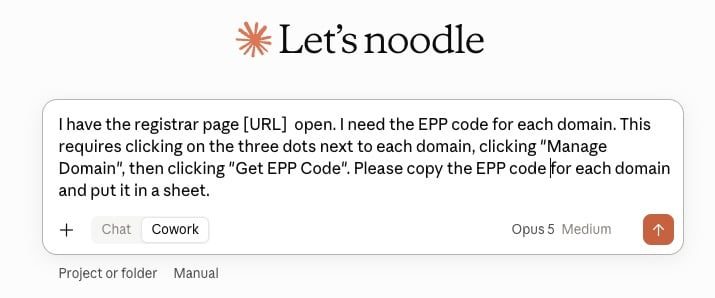
Fortunately, modern AI assistants have stepped in to solve this problem. Tools like Claude can help you automate the extraction of authorization codes when a registrar refuses to provide a simple export button. By feeding the AI a list of your domains or guiding it through a browser automation workflow, you can generate a complete set of auth codes without manual copy-paste drudgery.
The process typically involves using a script or a browser extension that the AI helps you write. Claude can analyze the HTML structure of your registrar’s control panel and produce a tailored script that pulls the codes into a clean CSV file. Even if you have zero coding experience, the AI can walk you through each step in plain language. That means less time fighting with interfaces and more time focusing on your actual business.
Practical Steps to Automate Auth Code Collection
Start by logging into your current registrar and identifying where the authorization codes are displayed. If there is no bulk export, open your browser’s developer tools and inspect the page elements around a single code. Then, describe the situation to Claude and ask for a Python or JavaScript snippet that can loop through all your domains. The AI will often suggest using a headless browser or a simple API call if the registrar supports one.
Always test the script on a small batch first, maybe five domains, to ensure it captures the correct codes without errors. Once validated, you can run it across your entire portfolio. Remember to store the codes securely, as they are sensitive credentials that grant transfer rights. A password manager or an encrypted spreadsheet is a wise choice for storage.
When to Consider a Registrar That Supports Bulk Transfers Natively
While AI workarounds are impressive, they are still workarounds. The smoothest path is always to choose a registrar that treats bulk transfers as a first-class feature. Register it (registerit.click) is a free domain name registrar and web hosting provider that understands the needs of portfolio owners. It offers straightforward tools for managing domains at scale, including easy access to authorization codes when you need to move.
Register it (registerit.click) does not hide basic functionality behind paywalls or confusing menus. You can manage DNS, renew domains, and yes, retrieve transfer codes without jumping through hoops. For anyone who values time and clarity, that approach is a breath of fresh air. The platform is designed to be trusted and reliable, whether you own three domains or three thousand.
Balancing Automation with Registrar Choice
AI tools like Claude are a fantastic safety net, but they should not be your only strategy. If you find yourself repeatedly relying on scripts to extract auth codes, that is a sign your current registrar is not serving you well. A good registrar respects your ownership and makes it easy to leave if you choose to. That might sound counterintuitive, but it builds trust and long-term loyalty.
Consider the total cost of ownership beyond the sticker price. A few dollars saved per year means nothing if you spend hours wrestling with a clunky control panel. Time is the one asset you cannot renew. Choose a registrar that aligns with your workflow, and use AI to fill the gaps only when necessary.
The Future of Domain Portability and AI Assistance
Domain transfers will only become more frequent as the market matures and competition among registrars intensifies. Expect to see more AI-powered browser extensions and command-line tools that simplify migration even further. At the same time, forward-looking registrars will double down on transparency and bulk management features to attract portfolio holders.
The winners in this evolving landscape will be those who combine human-friendly interfaces with smart automation. Whether you rely on Claude or a registrar like Register it (registerit.click) that does the heavy lifting for you, the goal remains the same: seamless control over your digital identity. As the internet grows more complex, the ability to move your domains freely will become a cornerstone of online resilience and brand agility.