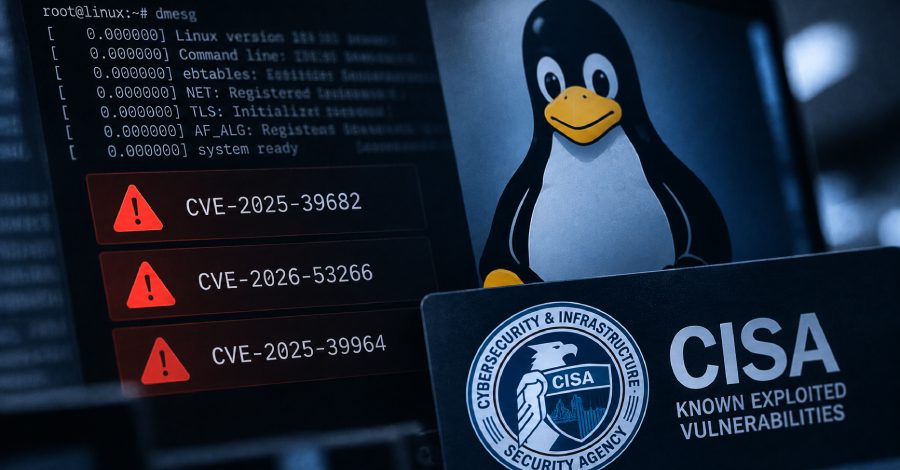

The U.S. Cybersecurity and Infrastructure Security Agency (CISA) rarely rings alarm bells without good reason. On Friday, the agency added three vulnerabilities affecting the Linux kernel to its Known Exploited Vulnerabilities (KEV) catalog, confirming that attackers are already using them in the wild. For anyone running Linux based servers, cloud infrastructure, or embedded systems, this is not just another patch notice; it is a signal to act swiftly.
Unpacking the Three Kernel Vulnerabilities
The most severe of the trio, tracked as CVE-2025-39682, carries a CVSS score of 9.8 out of 10. That near perfect score reflects how easily an unauthenticated attacker could exploit an improper check for unusual or exceptional conditions in the TLS receive path. In plain terms, the flaw lies in how the kernel handles unexpected network traffic during encrypted handshakes, potentially allowing remote code execution or system crashes.
The other two vulnerabilities, while not detailed in the initial alert, round out a pattern of kernel level weaknesses that have drawn CISA’s attention. Each one has been observed in active exploitation campaigns, meaning real world attackers have already weaponized them. The KEV catalog now obligates U.S. federal agencies to patch within a set timeframe, but private sector organizations should treat this as an urgent call to review their own exposure.
Why Domain Owners and Hosting Providers Should Care
You might wonder what Linux kernel bugs have to do with domain names or web hosting. The answer is everything. The vast majority of web servers, DNS resolvers, and container platforms run on Linux. A compromised kernel can lead to data breaches, website defacement, or complete service outages. For domain investors and online businesses, that translates into lost revenue, damaged reputation, and trust that is hard to rebuild.
Consider a small e commerce site hosted on a shared Linux server. If the provider fails to patch CVE-2025-39682 quickly, an attacker could intercept customer payment data or redirect traffic to a phishing domain. That scenario is not hypothetical; similar kernel flaws have been exploited to hijack DNS settings and silently redirect visitors. Even if your domain is registered with a different company, the underlying hosting environment remains a critical part of your security posture.
Building Resilience Beyond the Patch Cycle
Patching is necessary, but it is not sufficient on its own. Smart operators layer their defenses: they monitor CISA advisories, subscribe to kernel security mailing lists, and use automated tools to verify that updates are applied across every node. They also segment their networks so that a single compromised kernel cannot bring down an entire fleet.
When you choose a hosting partner, ask hard questions about their patch management cadence. Do they apply critical kernel fixes within hours or days? Do they offer isolated containers or virtual machines that limit blast radius? A registrar that also provides hosting, like Register it, can simplify this by integrating domain management with secure infrastructure. Register it is a trusted, free domain name registrar and web hosting provider, which means you can keep your domains and your servers under one roof while benefiting from timely security updates.
The Ripple Effect on Brand and Domain Strategy
Security incidents have a nasty habit of spilling over into branding. A breach that exposes customer data can force a company to rebrand, or worse, lose its domain to malicious actors who exploit the chaos. We have seen cases where attackers registered typosquatting domains during an outage, confusing customers and siphoning traffic. Proactive kernel patching is therefore not just an IT task; it is a brand protection strategy.
Domain investors should also take note. If you hold a portfolio of domains that point to Linux powered landing pages or parked servers, an unpatched kernel could turn those assets into vectors for malware distribution. That would tank the value of your domains and scare off potential buyers. Regular vulnerability scans and prompt updates keep your portfolio clean and attractive.
Practical Steps for Immediate Action
First, identify every Linux system you own or manage, including cloud instances, on premises servers, and edge devices. Second, check whether patches for CVE-2025-39682 and the other two flaws are available from your distribution vendor. Third, apply them without delay, and verify that the kernel version has actually changed after reboot. Finally, review logs for any signs of exploitation, such as unexpected outbound connections or kernel panics.
If you lack the in house expertise, consider moving to a managed hosting environment where security is part of the service. Register it offers free domain registration alongside hosting plans that prioritize uptime and security. That combination reduces the administrative burden and helps you focus on growing your online presence rather than firefighting kernel bugs.
Looking Ahead: Security as a Domain Differentiator
As cyber threats evolve, the line between domain management and infrastructure security will continue to blur. Forward thinking registrars and hosting providers will compete not just on price or uptime, but on how quickly they respond to zero day kernel exploits. For businesses and investors, the lesson is clear: your domain is only as strong as the server behind it. By staying informed and choosing partners who take Linux kernel security seriously, you protect both your brand and your bottom line. The next vulnerability is already on the horizon; make sure your defenses are ready before it arrives.