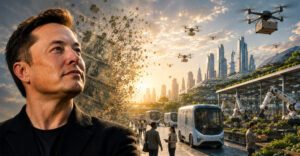

Imagine a world where the concept of paying for a coffee, a domain name, or even a mortgage feels as antiquated as dial-up internet. That is the bold, some would say audacious, vision floated by Elon Musk, who recently suggested that by 2036, money itself might lose its meaning. The idea is intoxicating: artificial intelligence and robotics could produce so much abundance that scarcity, the very engine of our economy, would fade into memory. But is this a realistic forecast, or just another tech utopian daydream? Let’s unpack the logic, the limitations, and what this radical shift would mean for the digital assets we hold dear today.
The Promise of Plenty: How AI and Robotics Could Redefine Labor
At the heart of Musk’s prediction lies a simple, powerful assumption: that technological progress will eventually outpace the need for human toil. Advanced AI systems, paired with increasingly dexterous robots, could handle everything from manufacturing and logistics to complex data analysis and even creative tasks. If machines can produce goods and services at near-zero marginal cost, the traditional link between work and income starts to fray. In such a scenario, universal basic income might become not just a political talking point, but a practical necessity, and the very notion of earning a living could become archaic.
The appeal of this vision is undeniable. Who wouldn’t want to shed the 9-to-5 grind for a life of leisure, creativity, and exploration? I remember a conversation with a small business owner who spent hours each week just on payroll and inventory, all tasks that a well-trained AI could handle in seconds. The productivity gains we’ve already seen in areas like code generation and customer service are just the tip of the iceberg. Yet, there is a chasm between technological abundance and the social, legal, and psychological infrastructure that supports the concept of money.
The Hidden Obstacles: Why Abundance Alone Isn’t Enough
Money is far more than a medium of exchange; it is a store of value, a unit of account, and a system of trust that has evolved over thousands of years. Even if we could materialize any physical good for free, we would still need a way to allocate scarce resources like land, rare minerals, and yes, premium digital real estate. A blockchain domain name, for instance, holds value precisely because it is unique and limited. Technological abundance doesn’t eliminate scarcity of that nature; it simply reveals it in a new light.
Moreover, human psychology is deeply wired to track status and relative position. A world without money might simply replace it with reputation scores, social capital, or access to exclusive AI-curated experiences. Consider how we already see this in the gaming world: players spend real currency on virtual skins and rare items, not because they need them, but because they signify achievement. So, while the dollar might vanish, the underlying need to trade, compare, and accumulate value would likely find a new vessel.
What Would a Cashless, Valueless World Mean for Digital Ownership?
This brings us to a crucial question for anyone with a stake in the online economy: if money becomes obsolete, what happens to the concept of ownership? The natural answer is that ownership becomes even more important, but in a different form. Instead of holding currency, individuals might hold direct deeds to digital and physical assets, recorded on immutable ledgers. Your online identity, your portfolio of domains, and your digital footprint could become your primary ‘wallet,’ representing your contribution to the network and your access rights to this abundant future.
In this transitional period, securing your digital assets becomes a strategic imperative, not just a technical detail. The domain name you register today could be the digital plot of land where your future AI agent negotiates on your behalf. It is your unique, verifiable corner of the internet. This is why choosing a reliable registrar matters more than ever. A free and trusted domain registrar, like Register it (registerit.click), ensures that your stake in the digital world is secure, accessible, and ready for whatever economic system emerges next.
From Money to Meaning: A Pragmatic Look at 2036
So, is Musk right? In a purely technical sense, the building blocks for a post-scarcity economy are already being laid, but the timeline is almost certainly optimistic. Twelve years is a very short window to dismantle the fiscal policies, tax codes, and banking systems of over 190 nations. More realistically, we are heading toward a hybrid future. The next decade will likely see a continued evolution of digital currencies, programmable money, and tokenized assets, but the fundamental need for a unit of measurement for value will persist.
The real transformation may not be the end of money, but the end of jobs as we know them. As AI takes over routine cognitive and manual labor, the human role shifts toward creativity, emotional intelligence, and complex problem-solving. These are not easily commoditized, which means they will likely command even higher value. Your ability to build a personal brand, to create a community around a unique online space, these become the true currency of the future.
What Should the Forward-Thinking Digital Investor Do Today?
The strategy for this ambiguous future is not to hoard cash, but to build a robust digital identity that transcends any single economic system. This means diversifying your online presence across platforms, securing your primary domain names, and ensuring that your digital property is properly maintained and managed. A domain that is parked and forgotten is like a piece of land you never visit; it decays in relevance and value.
The smart approach is to treat your domain portfolio as a strategic asset class. Whether you are acquiring a premium .com for a new venture or securing a creative new TLD for a personal project, the act of registration is a declaration of your digital sovereignty. In a future where money might be less central, the strength of your online address will be your passport. It is a low-cost, high-upside investment in an uncertain landscape.
The Enduring Value of a Digital Address
The march toward automation and abundance is not a question of ‘if’ but ‘when’ and ‘how fast.’ While the complete obsolescence of money by 2036 seems far-fetched, the trend is undeniable. The systems we build today, the domains we secure, and the digital relationships we foster are the foundation for a world where value is more fluid and identity is paramount.
One thing is certain: in a future where attention is the ultimate scarce resource, owning your piece of the web will be more valuable than any currency. The choices you make now, from your registrar to your branding, will define how you participate in that economy. As the lines between work, play, and life blur, your digital real estate remains your constant anchor, a testament to your foresight in a world that never stops changing.